Wondering what to call a Moon that is more than half lit but still growing? In astronomy, a waxing gibbous moon is the stretch between first quarter and full moon. More than half of the face we see is lit and the lit part grows each night. Any further meaning comes from tradition, not from the sky.
What is a waxing gibbous moon?
The Moon is always half lit by the Sun. Its phase is how much of that lit half faces Earth. During the waxing gibbous phase the Moon sits 90° to 180° east of the Sun along the Sun's yearly path, so we see most of its day side. "Gibbous" comes from the Latin for "humped", after the bulging shape.
In the table below, that angle is the Moon-Sun longitude gap. This is the Moon's eastward longitude difference from the Sun, counted around a full circle.
| Feature | Waxing gibbous | Source |
|---|---|---|
| Moon-Sun longitude gap | 90° to 180° | Wikipedia |
| Disc lit | More than half, growing | Wikipedia |
| Lit side, seen from the north | Right | Wikipedia |
| Rises | In the afternoon, before sunset | NASA |
| Sets | In the early morning, before sunrise | NASA |
| Average length | about 7.38 days | Wikipedia |
In the Southern Hemisphere the view is turned, so the lit side is on the left. For the full sequence, see the 8 moon phases. For the growing and shrinking halves of the cycle, see what waxing and waning mean.
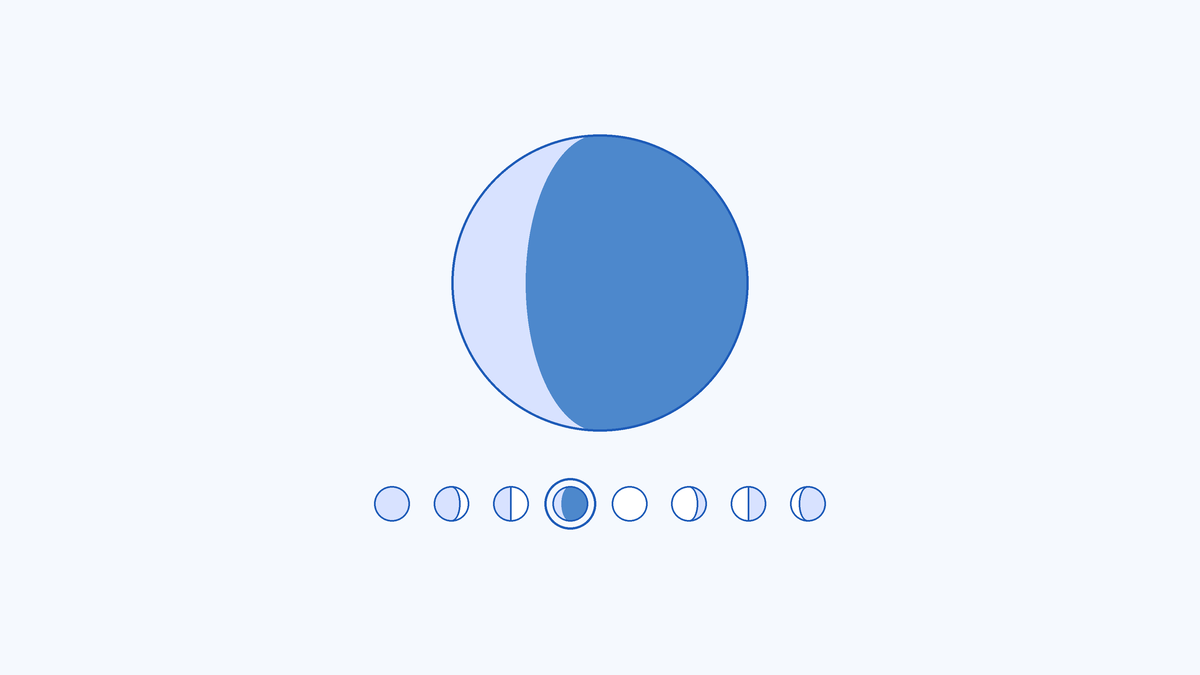
Waxing gibbous dates: November 2026 to January 2027
Each stretch runs from first quarter to full moon. Lengths vary because the Moon's orbit is slightly elliptical.
| Starts (first quarter) | Ends (full moon) | Length |
|---|---|---|
| 17 Nov 2026, 11:48 | 24 Nov 2026, 14:54 | 7.13 days |
| 17 Dec 2026, 05:43 | 24 Dec 2026, 01:28 | 6.82 days |
| 15 Jan 2027, 20:35 | 22 Jan 2027, 12:17 | 6.65 days |
Times are in UTC, rounded to the nearest minute, from NASA JPL's DE421 ephemeris (calculated with the Skyfield library). Your local date can differ.
- Sun238
- Moon3
Sun 238.2°, Moon 3.4°. 3.4 − 238.2 = −234.8. Add 360 to get 125.2°, which is between 90° and 180°.
The Moon is a waxing gibbous on this date, with about 79% of its disc lit.
What does a waxing gibbous moon mean in tradition?
Three examples show how traditions read the growing Moon.
- The Hindu calendar. The days from new moon to full moon form Shukla Paksha, "the bright lunar fortnight". Wikipedia's summary says this fortnight "is considered auspicious". The waxing gibbous days fall at its end.
- Biodynamic farming. Its followers choose when to plant, tend or harvest partly by the phase of the Moon.
- Modern astrology. Dane Rudhyar's 1967 book The Lunation Cycle carries the subtitle A Key to the Understanding of Personality.
These are readings from traditions. The phase is a fact about the sky; its meaning is an interpretation. For the wider question, see is astrology real?
What this means for your day
For your day
Do
Look east in the late afternoon to catch a waxing gibbous moon rising before sunset.
Don't
Don't read the phase as a forecast for your week.
Questions people ask
Is a waxing gibbous moon almost full?
It is on its way to full moon, but it can range from just over half lit to nearly full. In November 2026 the waxing gibbous stretch ends at full moon on 24 November at 14:54 UTC.
How is it different from a waning gibbous moon?
The waxing gibbous comes before full moon and grows, while the waning gibbous comes after and shrinks. The thin waning crescent follows later in the cycle.
Can you see a waxing gibbous moon in daylight?
Often, yes. NASA notes that it rises in the afternoon before sunset, so it can already be up in a blue sky.
Sources
- NASA Science: Moon Phases. The half-lit Moon, the eight phases in order and when the waxing gibbous moon rises and sets.
- Wikipedia: Lunar phase. The angles of the phases, the share of the disc lit, the lit side, the 7.38-day average, the elliptical orbit and the origin of "gibbous".
- Wikipedia: Paksha. Shukla Paksha as the bright fortnight of the waxing moon, considered auspicious.
- Wikipedia: Biodynamic agriculture. Timing farm work by the phase of the Moon.
- Wikipedia: Dane Rudhyar. The 1967 book The Lunation Cycle and its subtitle.
- NASA JPL: Planetary and lunar ephemerides. The DE421 ephemeris behind the stretch times and the 20 November example.
- Skyfield on GitHub. The library used to calculate the times and positions from DE421.