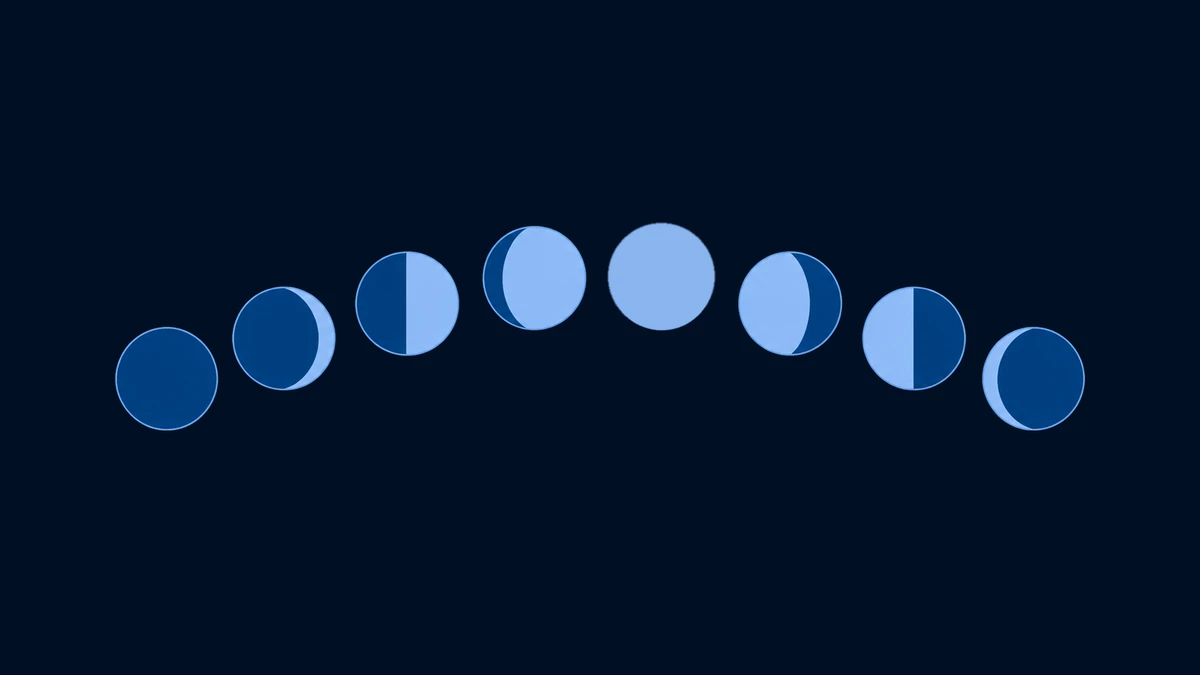
The 8 moon phases, in order, are new moon, waxing crescent, first quarter, waxing gibbous, full moon, waning gibbous, last quarter and waning crescent. Four are exact moments and four are the stretches between them. NASA calls last quarter third quarter. Both names are in use.
What are the 8 moon phases in order?
The Moon is always half lit by the Sun. The phase is how much of that lit half we can see from Earth. The angle column is the Moon's distance east of the Sun along the Sun's yearly path.
| Phase | Angle | What you see | This cycle (UTC) |
|---|---|---|---|
| New moon | 0° | Nothing: the lit side faces away from Earth | 9 Nov, 07:02 |
| Waxing crescent | 0° to 90° | A thin sliver that grows each day | 9 to 17 Nov |
| First quarter | 90° | Half of the lit side | 17 Nov, 11:48 |
| Waxing gibbous | 90° to 180° | Most of the lit side | 17 to 24 Nov |
| Full moon | 180° | The whole lit side, opposite the Sun | 24 Nov, 14:54 |
| Waning gibbous | 180° to 270° | More than half of the lit side, shrinking | 24 Nov to 1 Dec |
| Last quarter | 270° | Half of the lit side again | 1 Dec, 06:09 |
| Waning crescent | 270° to 360° | Less than half of the lit side, a sliver that shrinks each day | 1 to 9 Dec |
The in-between ranges exclude their end points: an exact 0°, 90°, 180° or 270° belongs to a principal phase.
The next new moon is on 9 December at 00:52 UTC. We calculated these times from the geocentric longitudes of the Sun and Moon. Times are in UTC, rounded to the nearest minute, from NASA JPL's DE421 ephemeris (calculated with the Skyfield library). Your local date can differ.
Eight is a convention. Wikipedia notes that traditional Hawaiian culture counts 30 phases, one per day. For the two halves of the cycle, see what waxing and waning mean. For the start of the cycle, see what is a new moon?. To find where the Moon is now, see which sign is the Moon in today?. For the Moon at your birth, see what is my moon sign?
How do I work out the moon phase on a date?
- Find the Sun's and the Moon's ecliptic longitude for that moment.
- Subtract the Sun's from the Moon's. If the result is negative, add 360.
- Find that angle in the table above.
- Sun230
- Moon266
Sun 230.1°, Moon 265.8°. 265.8 − 230.1 = 35.7°, which is between 0° and 90°.
The Moon is a waxing crescent on this date, with about 10% of its disc lit.
How long does each moon phase last?
The whole cycle takes about 29.5 days on average. Wikipedia gives 7.38 days as the average length of an intermediate phase, a quarter of the cycle. Real stretches differ, because the Moon's orbit is slightly elliptical and its speed changes.
| Stretch | Length |
|---|---|
| New moon to first quarter | 8.20 days |
| First quarter to full moon | 7.13 days |
| Full moon to last quarter | 6.64 days |
| Last quarter to new moon | 7.78 days |
That makes this cycle 29.74 days from new moon to new moon, longer than the average.
Your Personal Day number and today's Moon sign decide the day type. The Moon's phase doesn't affect the day type.
What this means for your day
For your day
Do
Look for the first quarter Moon high in the evening sky around 17 November.
Don't
Don't expect a phase time to match your clock: the table uses UTC.
Questions people ask
Is a half moon the same as a quarter moon?
Yes, in everyday speech. "Half moon" often means the first or third quarter, while "quarter" refers to the Moon's place in its cycle. NASA points out that you are seeing half of the lit half.
Do the phases look the same in the Southern Hemisphere?
The order is the same, but the view can be turned. Wikipedia compares looking south from the Northern Hemisphere with looking north from the Southern Hemisphere: the Moon looks rotated by 180 degrees. How it sits also depends on your latitude.
Does a moon phase affect people?
This page makes no claim about that. The phases are a fact about the sky; any meaning given to them is an interpretation.
Sources
- NASA Science: Moon Phases. The eight phases in order, what each looks like, the half-lit Moon, the 29.5-day cycle and when the first quarter Moon is high.
- Wikipedia: Lunar phase. The angles of the principal phases, the 7.38-day average, the 30 Hawaiian phases, half moon and quarter and the Southern Hemisphere view from a stated direction.
- NASA JPL: Planetary and lunar ephemerides. The DE421 ephemeris behind the phase times, the stretch lengths and the 12 November example.
- Skyfield on GitHub. The library used to calculate the times and positions from DE421.