A new moon is good for keeping time and for seeing a dark sky. It is the moment the Moon and the Sun line up in the sky, so the Moon's lit side faces away from Earth and, around that moment, the Moon can't be seen. This guide uses the new moon of 9 November 2026 at 07:02 UTC as its worked example.
What happens at a new moon?
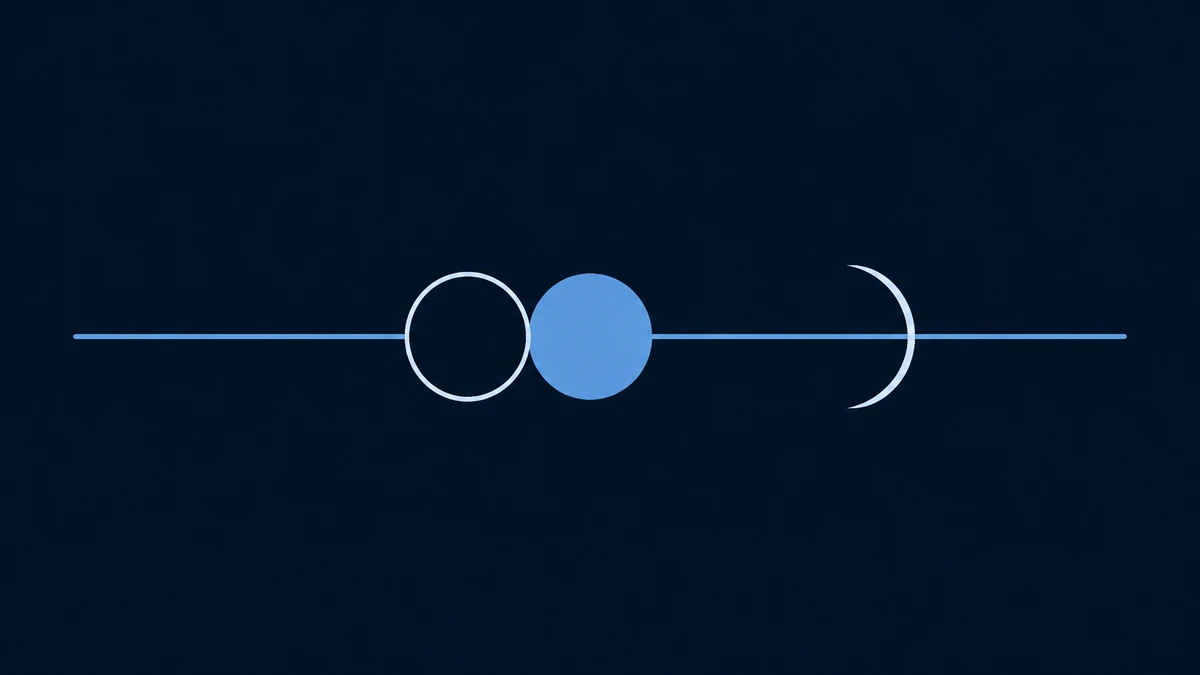
In astronomy, the new moon is the moment the Moon and the Sun have the same ecliptic longitude, their position along the Sun's yearly path. The Sun and the Moon are on the same side of Earth, so the Moon's night side faces us.
This is the invisible phase of the Moon, with the illuminated side of the Moon facing the Sun and the night side facing Earth.
The new moon is one moment, the same everywhere on Earth. Only the clock time changes with your time zone.
- Sun227
- Moon227
- NY-5
- TYO+9
Sun 226.9°, Moon 226.9°: the same longitude, about 17° Scorpio. New York: 07:02 - 5 h = 02:02 Mon 9 Nov. Tokyo: 07:02 + 9 h = 16:02 Mon 9 Nov.
The Sun and Moon share about 17° Scorpio, at 02:02 in New York and 16:02 in Tokyo, both on Monday 9 November.
Which traditions count time from the new moon?
The four calendars below tie their months to the new moon, each by its own rule. A month starts on a calendar date, not at the exact instant of the new moon. The modern Hebrew calendar, for example, follows calculated rules. The US Naval Observatory notes that its calculated new moon "does not coincide with the actual time of new moon". In Islamic traditions that use crescent sightings, a month begins with the first visible crescent; other communities use calculated calendars.
| Calendar | What the new moon marks |
|---|---|
| Hebrew | The start of every month (Rosh Chodesh), set by calculated rules |
| Chinese | The beginning of the month |
| Islamic (Hijri) | A new month once the first crescent is seen, in traditions that use sightings |
| Hindu, amanta system | The end of each lunar month, on the new moon day |
When can you see the Moon again?
Not around the moment of the new moon: then the Moon rises and sets with the Sun. A day or two later a thin crescent can show low in the western sky just after sunset; when it first shows depends on where you are and how clear the sky is. That first crescent was the original meaning of "new moon". It still starts the month in Islamic traditions that use crescent sightings.
Calculated from NASA JPL's DE421 ephemeris with the Skyfield library, the Moon is about 1% lit 24 hours after this new moon, about 4% lit after 48 hours and about 8% lit after 72 hours. A dark sky is the other use. Wikipedia's article on the Messier marathon, a night of finding as many of Messier's galaxies and star clusters as possible, says the dark nights around the new moon are best for it.
This new moon is not an eclipse. The Moon's orbit is tilted about 5° to Earth's, so a solar eclipse can happen only at a new moon that falls close to the Sun's path. On 9 November the Moon is about 5° south of that path. The first solar eclipse after it is an annular one on 6 February 2027.
Which new moons follow the one on 9 November 2026?
The four below, each with the sign the Sun and the Moon share at that moment. Times are in UTC, rounded to the nearest minute, from NASA JPL's DE421 ephemeris (calculated with the Skyfield library).
| Date | Time | Sign |
|---|---|---|
| 9 December 2026 | 00:52 | Sagittarius |
| 7 January 2027 | 20:24 | Capricorn |
| 6 February 2027 | 15:56 | Aquarius |
| 8 March 2027 | 09:29 | Pisces |
For the sign on any other date, see which sign the Moon is in today.
What this means for your day
For your day
Do
Look low in the west just after sunset on 10 or 11 November 2026 for the first crescent.
Don't
Don't look for the Moon at 07:02 UTC on 9 November 2026: it is too close to the Sun.
Questions people ask
How often is there a new moon?
On average, about 29.5 days pass between new moons. Any one gap can run from about 29.26 to 29.80 days. The year 2026 has 12 new moons.
Is a new moon the same as a solar eclipse?
No. A solar eclipse can happen only at a new moon, but because the Moon's orbit is tilted, the Moon usually passes a little above or below the Sun. Then there is no eclipse.
What sign is the new moon in on 9 November 2026?
Scorpio, at about 17° in the tropical zodiac. The Sun and the Moon are both there at the moment of the new moon.
Sources
- NASA Science: Moon Phases. The invisible phase; it rises and sets with the Sun.
- Wikipedia: New moon. Definition, first crescent, month length, Hebrew, Chinese and Islamic months, eclipses.
- US Naval Observatory: Phases of the Moon and Percent of the Moon Illuminated. The first crescent starts an Islamic month.
- Wikipedia: Messier marathon. The dark nights around the new moon are best for a Messier marathon.
- Wikipedia: Lunar phase. At new moon the Sun and Moon are aligned on the same side of Earth.
- US Naval Observatory: The Jewish Calendar. The calendar is based on computations; its calculated new moon does not coincide with the actual time of new moon.
- Wikipedia: Hindu calendar, Amānta and Purnimānta systems. The amanta tradition ends the lunar month on the new moon day.
- NASA Eclipse Web Site: Catalog of Solar Eclipses, 2001 to 2100. Lists 6 February 2027 as an annular (A) eclipse.
- NASA JPL: Planetary and lunar ephemerides. The DE421 ephemeris behind how much of the Moon is lit after the 9 November 2026 new moon, plus the four new moon times and signs that follow it.
- Skyfield on GitHub. The library used to calculate those times and positions from DE421.
- E. G. Richards, "Calendars", chapter 15 of the Explanatory Supplement to the Astronomical Almanac, US Naval Observatory copy. Page 588: the Islamic calendar as it depends on crescent sightings and the civil Islamic calendar as a rule-based one.