Waxing means the lit part of the Moon is growing, night by night, from new moon to full moon. Waning means it is shrinking, from full moon back to new moon, and the Moon switches between the two at every new and full moon.
What are the waxing and waning phases?
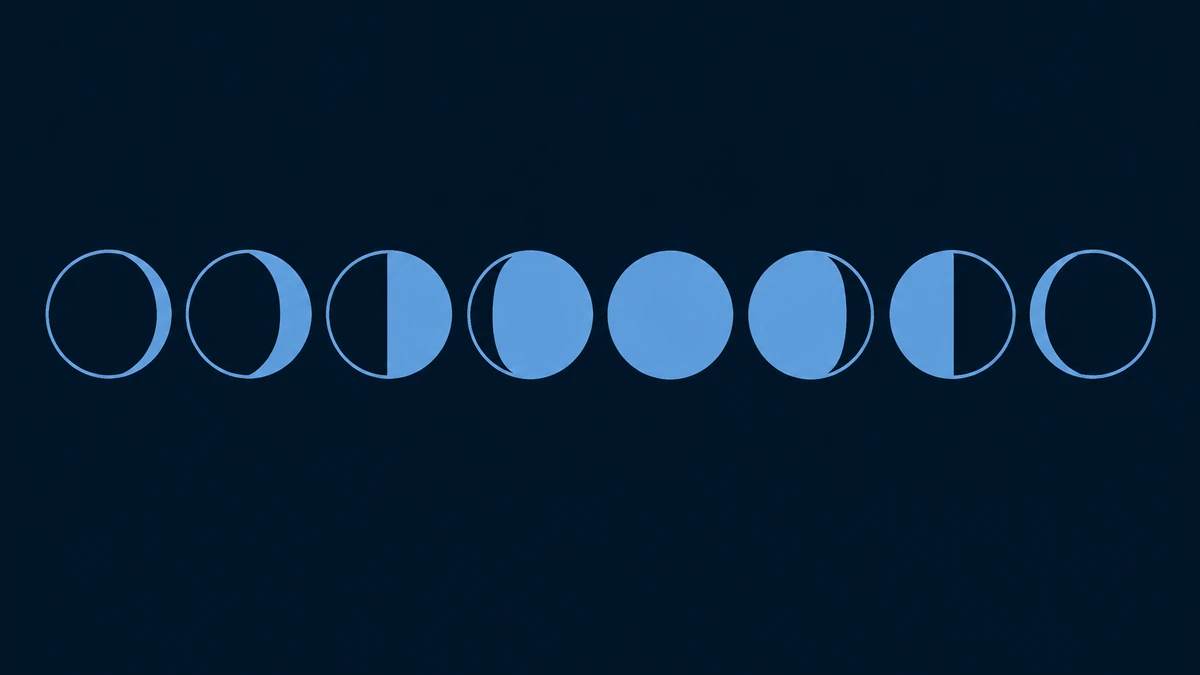
NASA lists eight phases in order: new Moon, waxing crescent, first quarter, waxing gibbous, full Moon, waning gibbous, third quarter and waning crescent. The third quarter is also called the last quarter.
The Moon is always half-lit by the Sun.
What changes is how much of that lit half faces Earth. Here is the current cycle:
| Phase | Waxing or waning | When (UTC) |
|---|---|---|
| Full moon | Turning point | 26 Oct, 04:12 |
| Waning gibbous | Waning | 26 Oct to 1 Nov |
| Last quarter | Waning | 1 Nov, 20:28 |
| Waning crescent | Waning | 1 to 9 Nov |
| New moon | Turning point | 9 Nov, 07:02 |
| Waxing crescent | Waxing | 9 to 17 Nov |
| First quarter | Waxing | 17 Nov, 11:48 |
| Waxing gibbous | Waxing | 17 to 24 Nov |
| Full moon | Turning point | 24 Nov, 14:53 |
The times are in UTC, so your local date can differ.
How long does the Moon wax or wane?
Each half lasts about two weeks. One full cycle takes about 29.5 days. The time from full moon to new moon, or from new moon to full, varies from about 13 days 22½ hours to about 15 days 14½ hours.
- F26
- N9
- Oct31
31 − 26 = 5 days to 31 Oct, then 5 + 9 = 14 days to 9 Nov, then 07:02 − 04:12 = 2 h 50 min.
This time the Moon wanes for about 14 days and 3 hours.
The waxing half that follows, from 9 to 24 November, lasts about 15 days and 8 hours. Computed with Astronomy Engine, an open-source library (version 2.1.19), the Moon is 54% lit at 12:00 UTC on 1 November and 23% lit on 4 November.
How can you tell if the Moon is waxing or waning?
At middle and high latitudes, a usual shortcut is to look at which side is lit:
- In the Northern Hemisphere, a Moon lit on the right is waxing, and a Moon lit on the left is waning.
- In the Southern Hemisphere, it is the other way round.
It doesn't always work. How the Moon tilts depends on your latitude and the season, so the lit side can look like it is at the bottom or the top instead, most often near the equator. The time and direction are a steadier guide: a waxing crescent shows in the western sky in the evening, and a waning crescent shows in the eastern sky in the morning.
What this means for your day
For your day
Do
Check the crescent's sky: evening in the west is waxing, morning in the east is waning.
Don't
Don't use the northern left-right rule in the Southern Hemisphere.
Questions people ask
Is a gibbous moon waxing or waning?
It can be either. A waxing gibbous comes just before full moon, and a waning gibbous just after it.
Why is it called a quarter when the Moon looks half lit?
Quarter refers to how far the Moon is through its cycle, not to its shape. At first quarter the Moon is a quarter of the way through its monthly journey, and you see half of its lit side.
How long is one cycle of Moon phases?
About 29.5 days, from one new moon to the next.
Sources
- NASA Science: Moon Phases. The eight phases in order, the Moon always half-lit, the first quarter, and the 29.5-day cycle.
- Wikipedia: Lunar phase. Waxing as thickening and waning as thinning, and the length of each half.
- NASA StarChild: Why is the crescent moon sometimes lit on the bottom?. Why the lit side can face sideways or down, depending on latitude and season.
- NASA Science: Top Moon Questions. Moon phases look reversed between the Northern and Southern Hemispheres.
- US Naval Observatory: Phases of the Moon, 2026. The phase dates and times in the table and the worked example, in UTC.