Mercury retrograde is a real, measurable appearance. Between 24 October and 13 November 2026 (UTC), Mercury's position in our sky slides back through Scorpio. At the same time, the planet keeps going forward around the Sun.
What part of Mercury retrograde is real?
The backward drift you see from Earth. Measure Mercury's position along the zodiac every few days and the numbers fall, then rise again. Measure the same planet as seen from the Sun and they only rise.
| Date | Seen from Earth | Seen from the Sun, degrees moved since 24 Oct |
|---|---|---|
| 24 Oct | 21.0° Scorpio | 0 |
| 29 Oct | 19.4° Scorpio | 23 |
| 3 Nov | 14.3° Scorpio | 50 |
| 8 Nov | 8.1° Scorpio | 79 |
| 13 Nov | 5.1° Scorpio | 111 |
| 18 Nov | 6.6° Scorpio | 141 |
Between its two stations, 24 October at about 07:15 UTC and 13 November at about 15:50 UTC, the backward arc seen from Earth is about 16 degrees. Over the same days, Mercury's forward orbit carries it about 114 degrees around the Sun.
It is not REAL in that the planet does not physically start moving backwards in its orbit
Why does Mercury look as if it goes backwards?
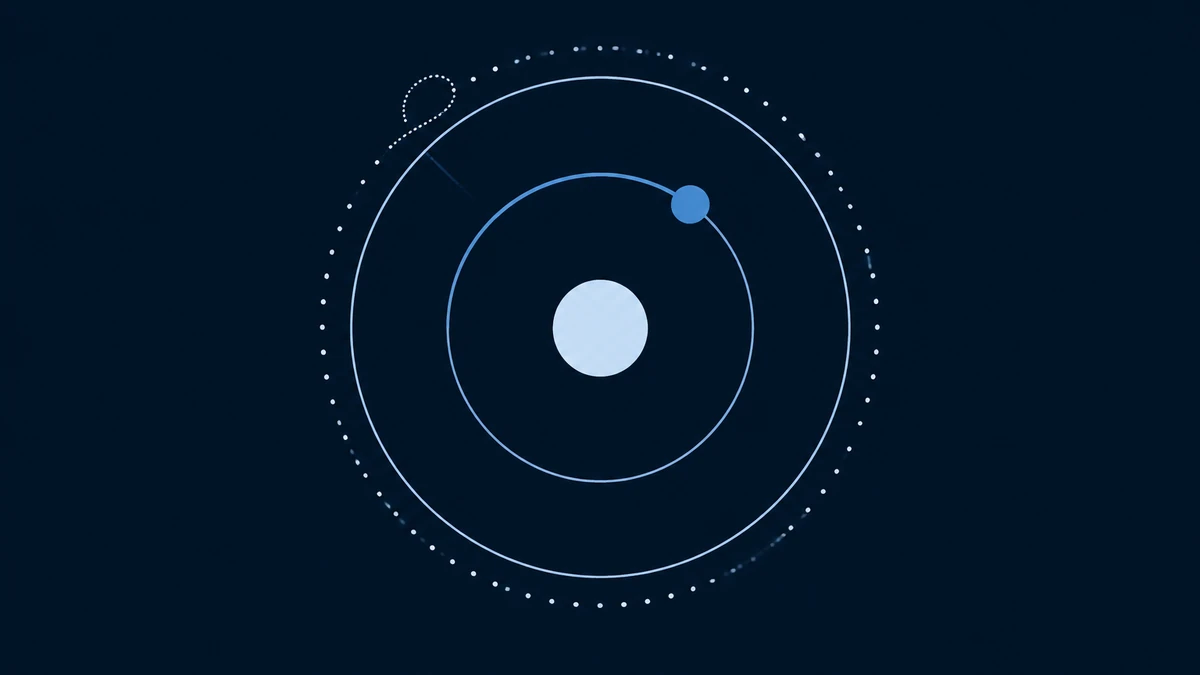
Mercury orbits closer to the Sun than Earth does. It is also faster: once every 88 Earth days. As it catches up with Earth and passes between Earth and the Sun, our line of sight to it swings the other way against the background stars.
This time Mercury passes between Earth and Sun on 4 Nov 2026, at about 14:20 UTC, near the middle of the retrograde. It is then less than half a degree from the Sun in our sky, so it is lost in the Sun's glare.
All positions here come from Astronomy Engine, an open-source astronomy library (version 2.1.19). Table rows are for 00:00 UTC on each date. The Earth view is Mercury's geocentric longitude in the tropical zodiac. The Sun view is the heliocentric longitude Mercury has gained, moving forward, since 00:00 UTC on 24 October.
Is the astrology of Mercury retrograde real?
That is a different question. The astronomy here shows only how Mercury moves in our sky. It says nothing about the personal meanings or the events in people's lives that astrology links to a retrograde.
In Western astrology, some astrologers include retrograde planets when they read a chart and some see a planet that was retrograde at birth as a potential weak point. Those are readings from a tradition. Its meaning for people is interpretation: the sky data neither confirms nor rules it out. A concrete claim about events, such as more delays during a retrograde, is a claim about the world. It can be checked against what actually happens.
What this means for your day
For your day
Do
Separate what the sky shows from what a horoscope says about it.
Don't
Don't treat Mercury's backward drift as proof of what a horoscope says about you.
Questions people ask
Can you see Mercury during this retrograde?
Not easily near the middle. Around 4 November it sits almost in line with the Sun and can't be seen in the glare; by 13 November it is about 16 degrees from the Sun.
Do other planets go retrograde?
Yes. Every other planet can appear to move backwards from Earth; the Sun and the Moon never do. Planets beyond Earth's orbit do it when Earth overtakes them.
Sources
- NASA StarChild: What does it mean for Mercury to be in retrograde?. Retrograde motion is apparent, not real.
- NASA Science: Mercury facts. Mercury goes around the Sun every 88 Earth days.
- NASA Science: What's Up, October 2022. Mars appears retrograde when Earth overtakes it while both continue forward around the Sun.
- Wikipedia: Apparent retrograde motion. Mercury's retrogrades are tied to its passes between Earth and the Sun.
- Wikipedia: Western astrology. How some astrologers read retrograde planets.
- Wikipedia: Planets in astrology. All planets except the Sun and the Moon can appear retrograde.
- Astronomy Engine, version 2.1.19. NinePath's own calculation of the table, the two station times, the 4 November pass and both arcs, using the method described above.