The World Birthday Study finds the most common birthday in 15 countries from official birth records. Coverage and years differ by source. A large set of records can still leave much of the world unrepresented.
Most common and rarest birthdays by country
A birthday means a calendar date here. We divide its births by how often it occurs in the source period. The least common birthday among regular dates excludes leap day.
| Country | Years | Most common birthday | Rarest regular birthday | Peak birth month per day | Lowest birth month per day |
|---|---|---|---|---|---|
| Netherlands | 1995–2025 | 24 September | 26 December | September | December |
| Metropolitan France | 1968–2025 | 7 May | 25 December | July | January |
| England and Wales | 1995–2025 | 26 September | 26 December | September | December |
| Denmark | 2007–2025 | 18 August | 24 December | July | December |
| United States (SSA) | 2000–2014 | 12 September | 25 December | September | January |
| Mexico | 1998–2021 | 30 August | 25 December | September | April |
| Japan | 1996–2025 | 25 September | 1 January | September | March |
| Germany | 2014–2024 | 21 September | 25 December | September | December |
| Belgium | 1992–2025 | 23 July | 25 December | July | November |
| Malaysia | 1990–2022 | 10 October | 1 May | September | January |
| Slovenia | 2000–2025 | 20 September | 1 November | September | December |
| New Zealand | 1980–2023 registrations | 27 September | 25 December | Not available from ranks | Not available from ranks |
New Zealand’s added row retains published registration-period ranks. Its month rates are unavailable. New country details, heat maps and source limits are on the method page. The original selected-country pool is unchanged.
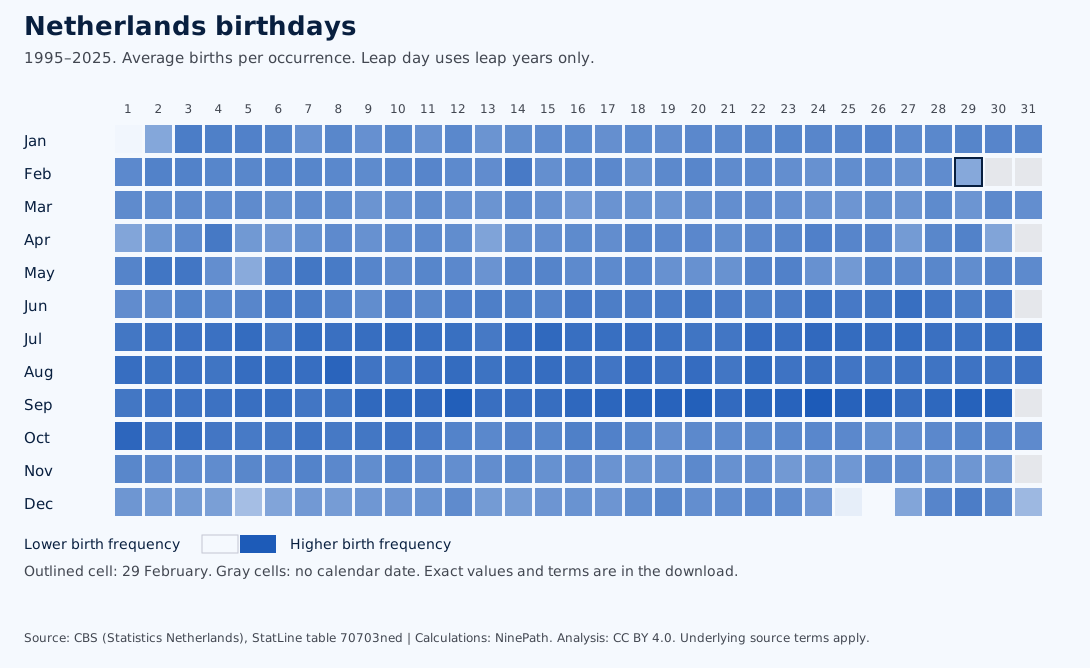
Netherlands: most common and rarest birthdays
In the Netherlands, the most common birthday in 1995–2025 was 24 September, averaging 549.03 births per occurrence. The rarest regular birthday was 26 December, with 356.06 births.
CBS covers births to registered residents. Reports in its undated “other” category are excluded.
Swipe to see the whole chart
See the detailed table on the method page.
Leap day: 29 February averaged 454.88 births across 8 occurrences. This uses leap years only.
Birth months: September led at 531.31 births per day. December was lowest at 469.55. These rates allow for the months’ different lengths.
Source: CBS (Statistics Netherlands), StatLine table 70703ned. Calculations by NinePath. Source table.
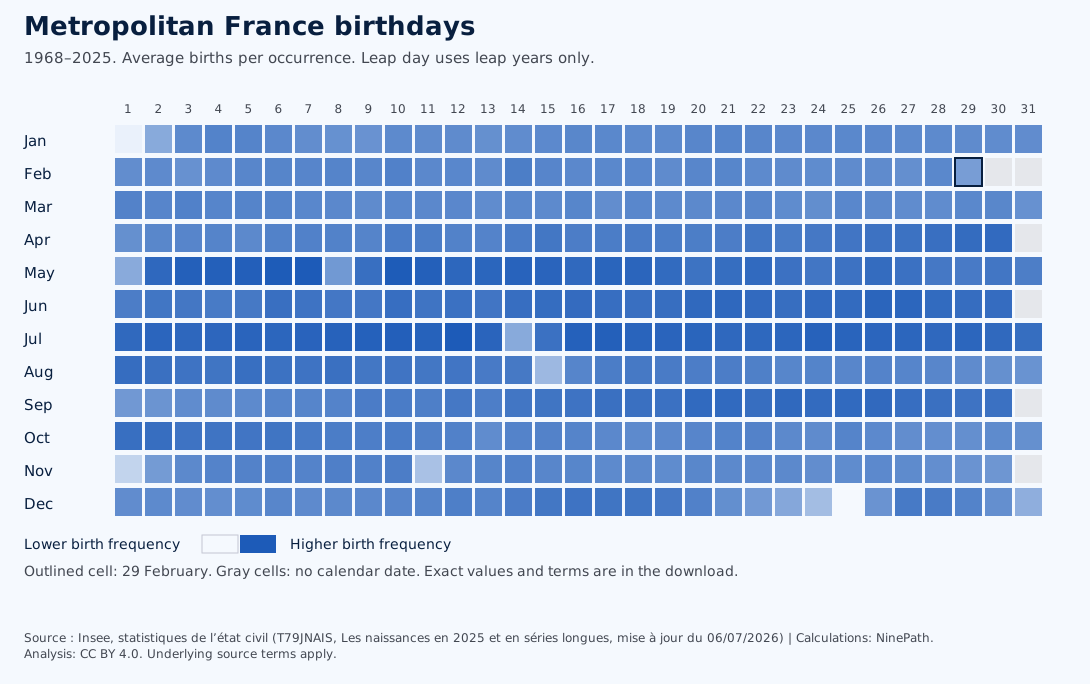
Metropolitan France: most common and rarest birthdays
In Metropolitan France, the most common birthday in 1968–2025 was 7 May, averaging 2,223.17 births per occurrence. The rarest regular birthday was 25 December, with 1,605.88 births.
This is metropolitan France. It is a consistent geographic series. The later whole-country series has different coverage and is not used for this ranking.
Swipe to see the whole chart
See the detailed table on the method page.
Leap day: 29 February averaged 1,963.80 births across 15 occurrences. This uses leap years only.
Birth months: July led at 2,175.09 births per day. January was lowest at 2,023.66. These rates allow for the months’ different lengths.
Source : Insee, statistiques de l’état civil (T79JNAIS, Les naissances en 2025 et en séries longues, mise à jour du 06/07/2026). Calculations by NinePath. Source table.
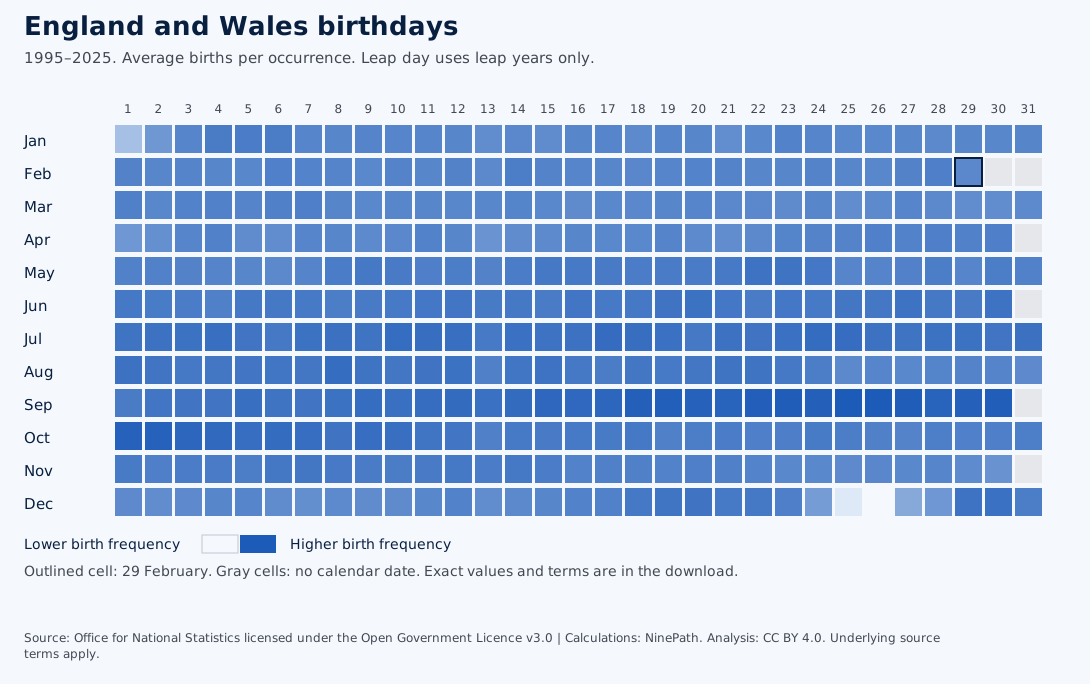
England and Wales: most common and rarest birthdays
In England and Wales, the most common birthday in 1995–2025 was 26 September, averaging 1,927.32 births per occurrence. The rarest regular birthday was 26 December, with 1,293.97 births.
This covers England and Wales. It is not a ranking for the whole United Kingdom. ONS late registrations are used as published.
Swipe to see the whole chart
See the detailed table on the method page.
Leap day: 29 February averaged 1,745.00 births across 8 occurrences. This uses leap years only.
Birth months: September led at 1,872.82 births per day. December was lowest at 1,729.48. These rates allow for the months’ different lengths.
Source: Office for National Statistics licensed under the Open Government Licence v3.0. Calculations by NinePath. Source table.
Denmark: most common and rarest birthdays
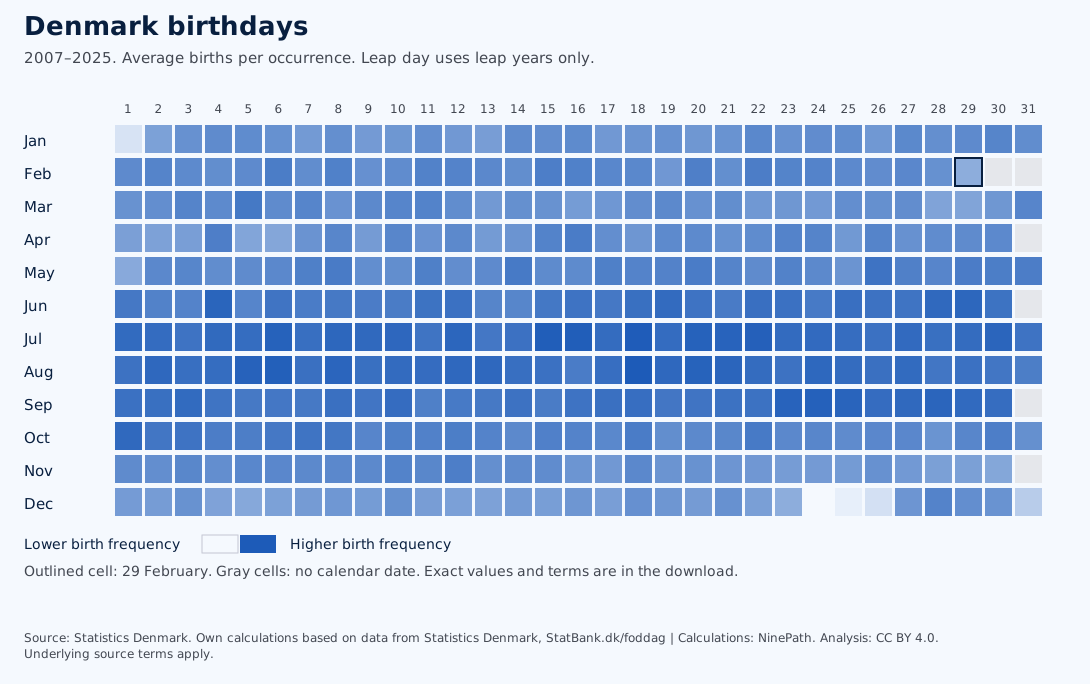
In Denmark, the most common birthday in 2007–2025 was 18 August, averaging 184.47 births per occurrence. The rarest regular birthday was 24 December, with 110.21 births.
Statistics Denmark covers the population in its Civil Registration System.
Swipe to see the whole chart
See the detailed table on the method page.
Leap day: 29 February averaged 146.00 births across 5 occurrences. This uses leap years only.
Birth months: July led at 177.50 births per day. December was lowest at 150.43. These rates allow for the months’ different lengths.
Source: Statistics Denmark. Own calculations based on data from Statistics Denmark, StatBank.dk/foddag. Calculations by NinePath. Source table.
United States (SSA): most common and rarest birthdays
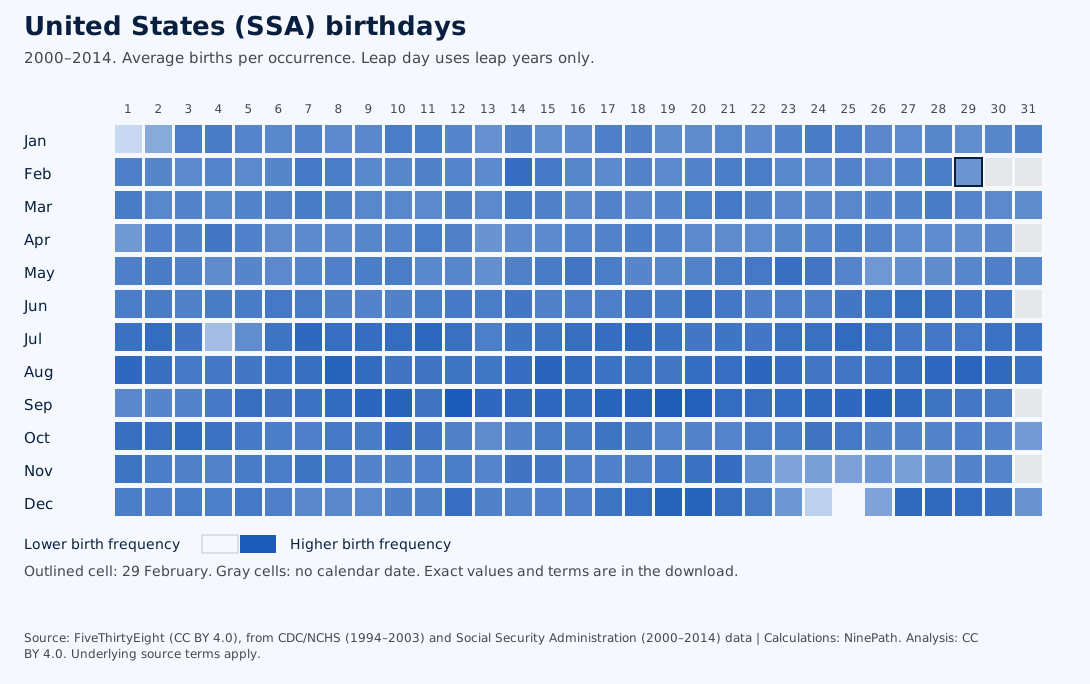
In the United States (SSA data), the most common birthday in 2000–2014 was 12 September, averaging 12,734.93 births per occurrence. The rarest regular birthday was 25 December, with 6,437.87 births.
This is US Social Security Administration data, 2000–2014. The listed archive republishes the agency data. Its annual totals differ from the CDC birth series. Treat this as the SSA series, rather than a count of everyone living in the US today.
Swipe to see the whole chart
See the detailed table on the method page.
Leap day: 29 February averaged 10,467.25 births across 4 occurrences. This uses leap years only.
Birth months: September led at 11,999.09 births per day. January was lowest at 10,908.79. These rates allow for the months’ different lengths.
Source: FiveThirtyEight (CC BY 4.0), from CDC/NCHS (1994–2003) and Social Security Administration (2000–2014) data. Calculations by NinePath. Source table.
Mexico: most common and rarest birthdays
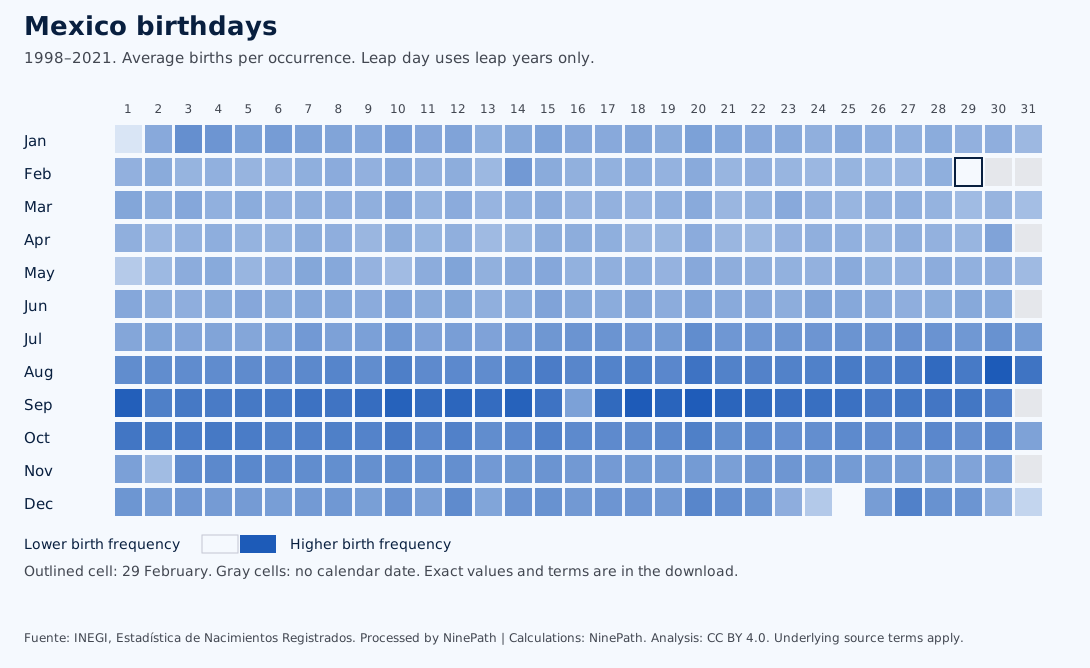
In Mexico, the most common birthday in 1998–2021 was 30 August, averaging 7,418.71 births per occurrence. The rarest regular birthday was 25 December, with 4,598.04 births.
These are birth years, rebuilt from registration files. Births outside Mexico are excluded. Birth years 2022 and later are omitted because late registrations leave them less complete. Records without a birth day in 2013 are dropped. Leap day is low even after adjustment for its occurrences. We have no verified cause for that pattern.
Swipe to see the whole chart
See the detailed table on the method page.
Leap day: 29 February averaged 4,595.00 births across 6 occurrences. This uses leap years only.
Birth months: September led at 7,033.10 births per day. April was lowest at 5,874.40. These rates allow for the months’ different lengths.
Fuente: INEGI, Estadística de Nacimientos Registrados. Processed by NinePath. Calculations by NinePath. Source table.
Japan: most common and rarest birthdays
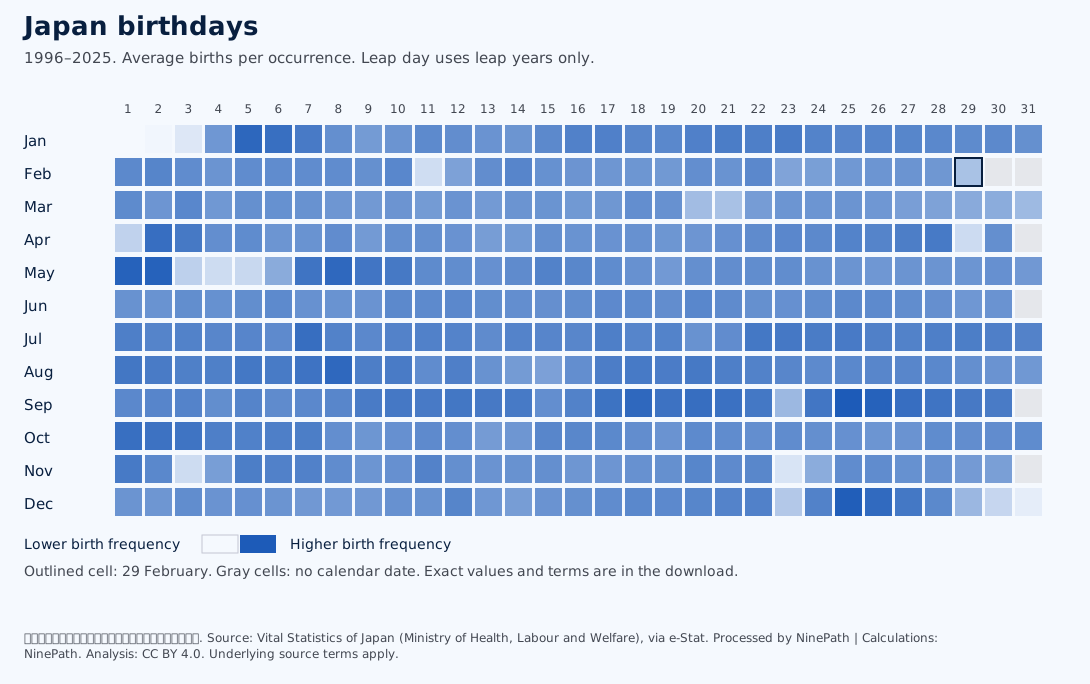
In Japan, the most common birthday in 1996–2025 was 25 September, averaging 3,189.03 births per occurrence. The rarest regular birthday was 1 January, with 1,877.43 births.
These records cover births to Japanese nationals in Japan. They exclude foreign nationals born in Japan and Japanese nationals born abroad.
Swipe to see the whole chart
See the detailed table on the method page.
Leap day: 29 February averaged 2,337.50 births across 8 occurrences. This uses leap years only.
Birth months: September led at 2,915.29 births per day. March was lowest at 2,662.85. These rates allow for the months’ different lengths.
出典:「人口動態調査」(厚生労働省)を加工して作成. Source: Vital Statistics of Japan (Ministry of Health, Labour and Welfare), via e-Stat. Processed by NinePath. Calculations by NinePath. Source table.
Canada: most common and rarest birthdays
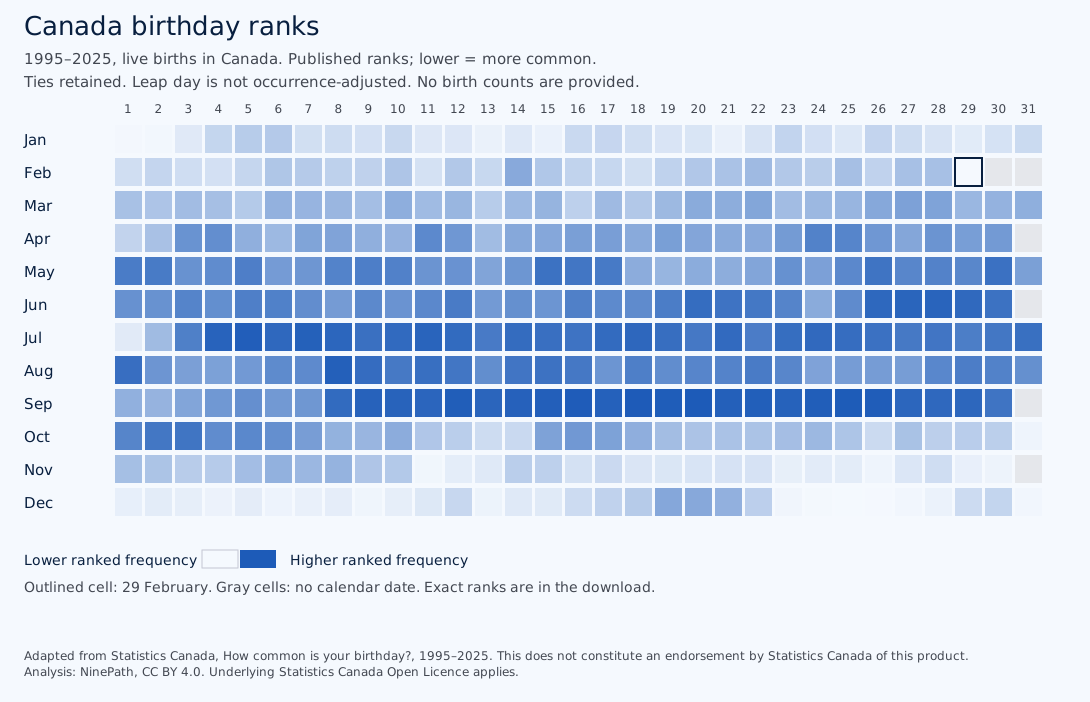
20 September leads Statistics Canada's published ranking for 1995–2025, live births in Canada. 25 December is the rarest regular date. This source supplies ranks, including ties. It does not supply birth counts or per-occurrence rates.
The published rank for 29 February is 366. We keep it as published and do not adjust it for occurrences. Its position is not comparable with the occurrence-adjusted leap-day rates in the full-study countries.
Swipe to see the whole chart
See the detailed table on the method page.
Ties retain the published rank. Canada is outside the pooled comparison. It has no life path distribution in this study.
Adapted from Statistics Canada, How common is your birthday?, 1995–2025. This does not constitute an endorsement by Statistics Canada of this product. Original chart.
Australia: most common and rarest birthdays
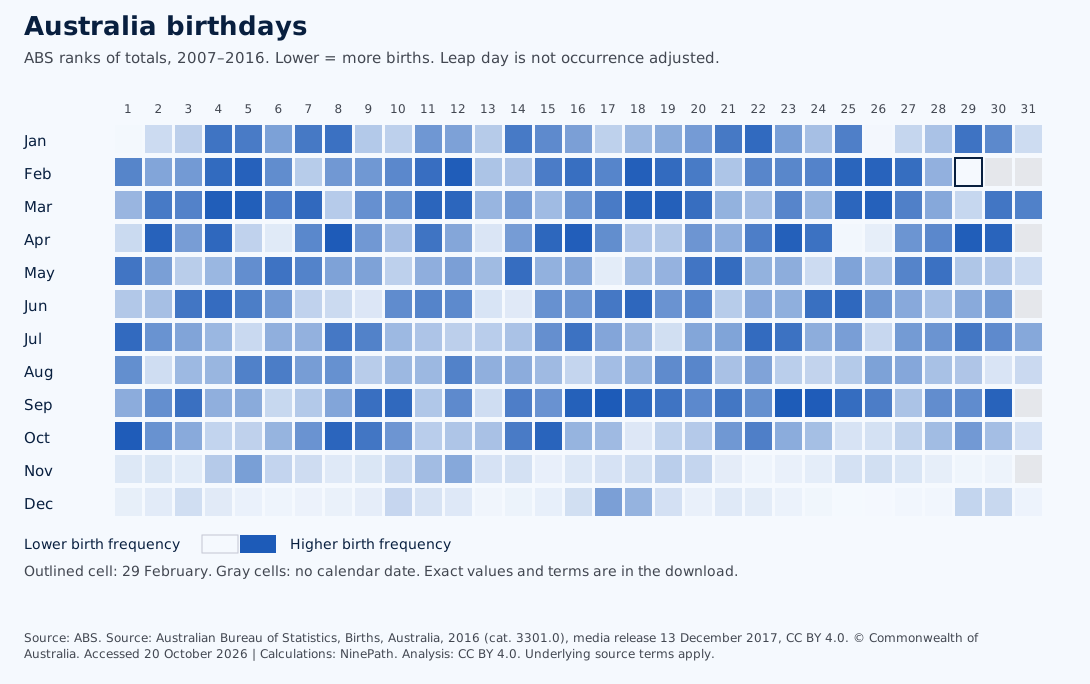
17 September leads the ABS ranking for 2007–2016. 25 December is the rarest regular birthday. ABS ranks totals across the period. It does not provide complete daily counts, so this section cannot use the per-occurrence ranking applied above.
ABS ranks 29 February last because it ranks totals over ten years. It occurred three times in 2007–2016. That rank cannot tell us where it would sit after adjusting for occurrences.
Swipe to see the whole chart
See the detailed table on the method page.
Ties retain the published ABS rank.
Source: ABS. Source: Australian Bureau of Statistics, Births, Australia, 2016 (cat. 3301.0), media release 13 December 2017, CC BY 4.0. © Commonwealth of Australia. Accessed 20 October 2026. Calculations by NinePath.
Ireland: most common and rarest birthdays
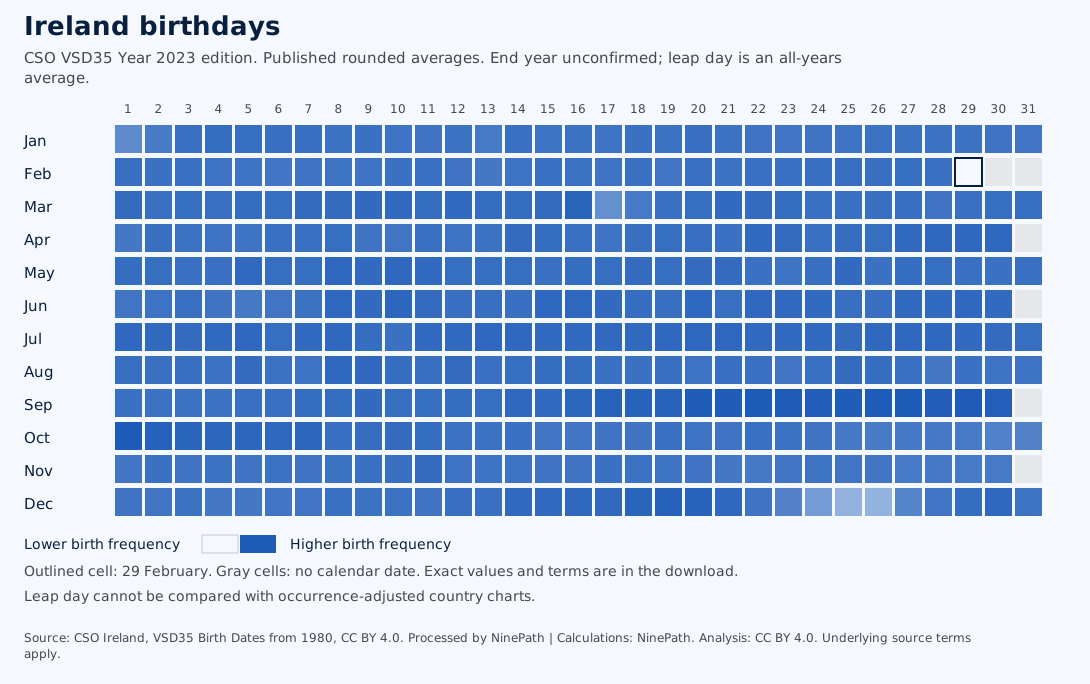
In the CSO VSD35 Year 2023 edition, “Average Birth Dates from 1980”, 22 September, 27 September, 1 October share the highest published average: 186 births. 26 December has the lowest average among regular dates. The published averages are rounded, so the leading dates tie here.
CSO labels its editions by year, but the table’s reference period is blank. We use its edition label and do not claim a confirmed final birth year. Leap day uses an all-years average in this table; we show it separately and do not adjust it using an inferred period.
Swipe to see the whole chart
See the detailed table on the method page.
Leap day: 29 February has a published all-years average of 42. It is not comparable with a leap-year-only average.
Source: CSO Ireland, VSD35 Birth Dates from 1980, CC BY 4.0. Processed by NinePath
A shared-period view
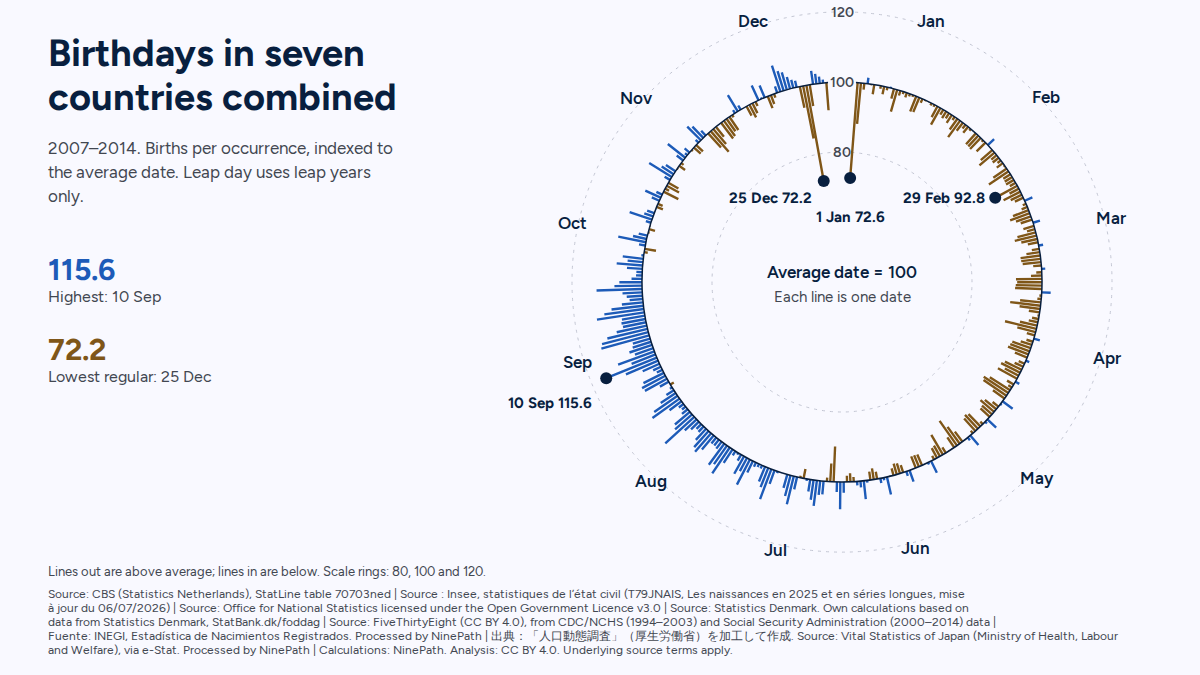
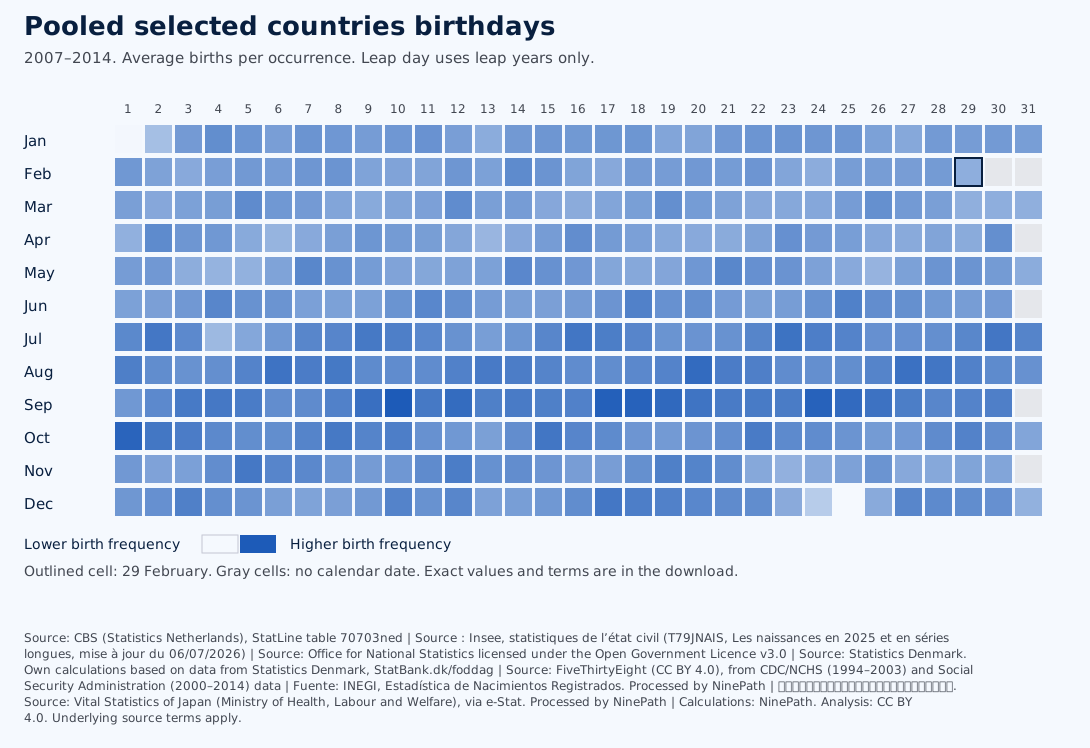
The pooled view covers 2007–2014 in the original seven selected countries. It adds raw counts, then divides by shared calendar occurrences. It does not average country percentages. The US and Mexico contribute most of the records, so the result is not a world estimate.
The pooled most common birthday is 10 September, at 29,291.00 births per occurrence. The rarest regular date is 25 December, at 18,289.50.
Swipe to see the whole chart
See the detailed table on the method page.
Leap day averaged 23,511.50 births across 2 shared occurrences.
Each country in the shared period
| Country | Most common birthday | Rarest regular birthday | Peak month per day |
|---|---|---|---|
| Netherlands | 10 September | 26 December | September |
| Metropolitan France | 24 September | 25 December | July |
| England and Wales | 1 October | 26 December | September |
| Denmark | 6 August | 24 December | July |
| United States (SSA) | 10 September | 25 December | September |
| Mexico | 18 September | 25 December | September |
| Japan | 25 December | 1 January | September |
Pooled birth months
In the pooled records from the seven countries (2007–2014), September had the most births per day (27,213.22) and April the fewest (24,430.38). These rates allow for the months’ different lengths. See the detailed table on the method page.
What is the most common birth month worldwide?
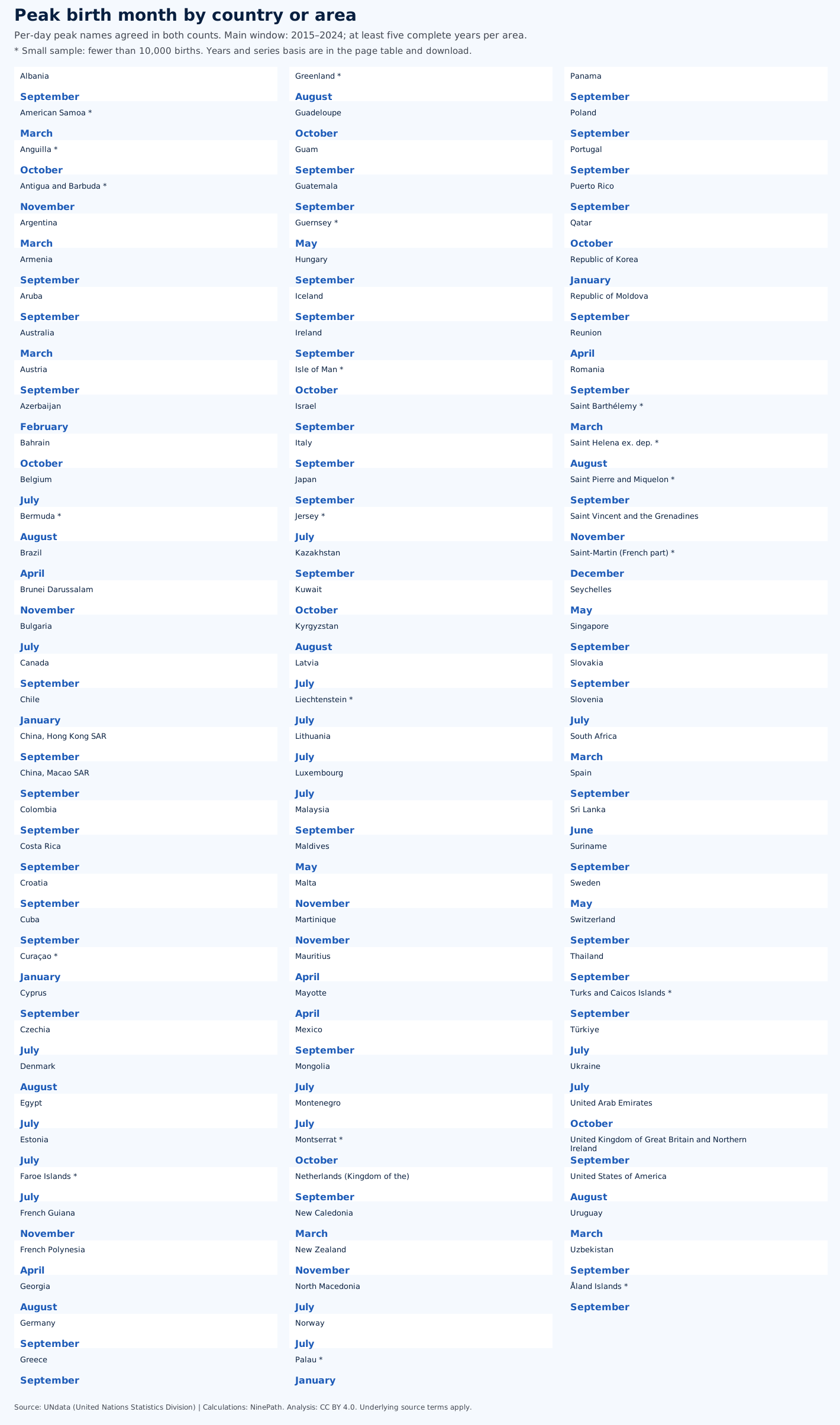
September often leads in this table, but it is not a confirmed global winner. Some countries are absent. The included periods and registration systems differ. Monthly data cannot establish the most common birthday in the world.
We publish the peak-month names that agreed for 106 countries and areas in two counts. The main window is 2015–2024, using at least five complete years per area. Each peak uses births per day, so longer months do not get an automatic advantage. The table includes territories as well as countries.
Cayman Islands, Finland, Oman and Serbia are omitted because the two selection rules gave different peaks. Their omission is a verification limit, rather than a claim that their peaks are statistically tied.
Swipe to see the whole chart
See the detailed table on the method page.
Small sample means fewer than 10,000 births across the years used. Small samples can move sharply from year to year.
Source: UNdata (United Nations Statistics Division). Calculations by NinePath.
Read the companion results
The study sits with our astrology guides. See the most common zodiac sign, the most common life path number and the sources and method. The method page explains the gaps and the independent recount.
Download the verified data table. The download contains only checked measures. Reuse terms and credits travel with the data.
Questions people ask
What is the most common birthday in the world?
In the pooled records from the seven countries we compared (2007–2014), 10 September was the most common birthday and 25 December the rarest regular date. This describes selected countries only, not a world figure.
What is the rarest birthday?
29 February occurs least often in the calendar. Among regular dates, 24, 25 or 26 December is the rarest in 12 of the 15 countries we cover. The exceptions are Japan (1 January), Malaysia (1 May) and Slovenia (1 November). We adjust leap day for its occurrences where counts permit it.
Is September the most common birth month?
September has the highest births per day in 43 of the 106 countries and areas with monthly UNdata. Periods vary (mostly 2015–2024) and coverage is incomplete, so this is not a world ranking.
Sources
- Source: CBS (Statistics Netherlands), StatLine table 70703ned
- Source : Insee, statistiques de l’état civil (T79JNAIS, Les naissances en 2025 et en séries longues, mise à jour du 06/07/2026)
- Source: Office for National Statistics licensed under the Open Government Licence v3.0
- Source: Statistics Denmark. Own calculations based on data from Statistics Denmark, StatBank.dk/foddag
- Source: FiveThirtyEight (CC BY 4.0), from CDC/NCHS (1994–2003) and Social Security Administration (2000–2014) data
- Fuente: INEGI, Estadística de Nacimientos Registrados. Processed by NinePath
- 出典:「人口動態調査」(厚生労働省)を加工して作成. Source: Vital Statistics of Japan (Ministry of Health, Labour and Welfare), via e-Stat. Processed by NinePath
- Source: ABS. Source: Australian Bureau of Statistics, Births, Australia, 2016 (cat. 3301.0), media release 13 December 2017, CC BY 4.0. © Commonwealth of Australia. Accessed 20 October 2026
- Source: CSO Ireland, VSD35 Birth Dates from 1980, CC BY 4.0. Processed by NinePath
- Source: UNdata (United Nations Statistics Division)
- Adapted from Statistics Canada, How common is your birthday?, 1995–2025. This does not constitute an endorsement by Statistics Canada of this product.
- Source: Statistischer Bericht - Geburten 2025, table 12612-20, Statistisches Bundesamt (Destatis), 2026; own calculations.
- Source: Statbel. Processed by NinePath.
- Source: data.gov.my / National Registration Department (JPN), CC BY 4.0. Processed by NinePath.
- Source: SURS. Processed by NinePath.
- This work is based on/includes Stats NZ’s data which are licensed by Stats NZ for reuse under the Creative Commons Attribution 4.0 International licence.