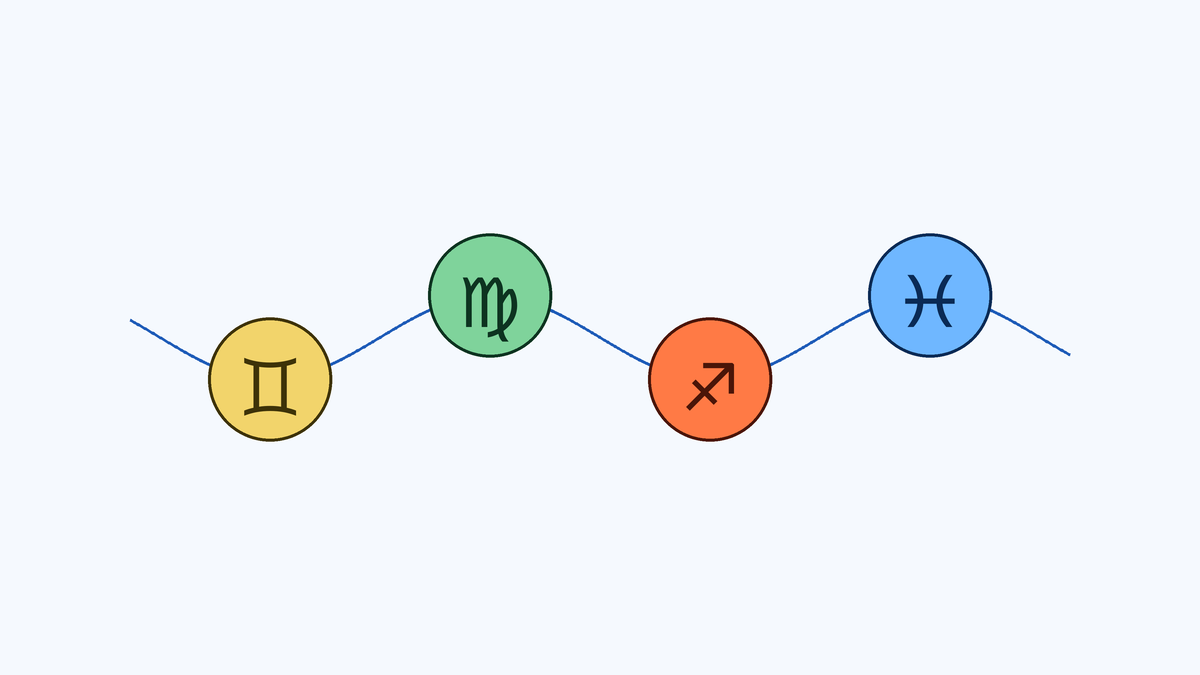
If people call your sign restless or hard to pin down, you may wonder where that idea starts. The mutable signs are Gemini, Virgo, Sagittarius and Pisces. They are the last sign of each season: when the Sun leaves one, it enters a new season at an equinox or a solstice.
Which signs are mutable?
Modality, in astrology, is a sign's position in its season. Wikipedia lists three modalities with four signs each: cardinal, fixed and mutable. The mutable group closes every season.
| Sign | Element | Symbol | Last sign of | Ends as the Sun reaches |
|---|---|---|---|---|
| Gemini | Air | Twins | Northern spring | 90°, the June solstice |
| Virgo | Earth | Maiden | Northern summer | 180°, the September equinox |
| Sagittarius | Fire | Archer | Northern autumn | 270°, the December solstice |
| Pisces | Water | Fish | Northern winter | 0°, the March equinox |
Each element has one mutable sign. They sit 90 degrees apart and pair off across the circle: Gemini faces Sagittarius and Virgo faces Pisces. South of the equator the season names flip, so Gemini closes autumn there.
Why do the mutable signs end the seasons?
The four seasons start at the equinoxes and solstices. Those are the first points of the four cardinal signs: Aries, Cancer, Libra and Capricorn. The sign just before each of them is mutable. The middle sign of each season is one of the fixed signs.
The Sun's exit from a mutable sign is the same moment as an equinox or a solstice. The next one is the December solstice, when the Sun leaves Sagittarius. Exact times are at when each zodiac season starts.
What does mutable mean in astrology?
In astrology, the mutable signs are linked with change. Wikipedia's table of modalities gives the keywords "Adaptability, flexibility, resourcefulness". It pairs mutable with mercury, one of the three alchemical primes.
Alan Leo's Astrology for All (1899) gives the mutable quality as "Emotion, Flexibility and Restlessness" (page 46). He notes that the mutable signs "are generally termed common signs by astrologers" (page 47). Each, he adds, is "composed of two characters" (page 48).
| Sign | Alan Leo's words |
|---|---|
| Gemini | "the twins" |
| Virgo | "the virgin" with ears of corn |
| Sagittarius | "the archer, half man, half horse" |
| Pisces | "the fishes" |
He sums up the group as belonging "to change, indecision and mutability" (page 48). These are readings from one tradition, not measured facts about anyone.
How do I find a sign's modality by season?
- Find the season the sign falls in, using the Northern names.
- Count its place in that season: first, second or third.
- First means cardinal, second means fixed and third means mutable.
- Sign9
Northern autumn begins with Libra at 180°. Its three signs are Libra (7), Scorpio (8) and Sagittarius (9), so Sagittarius is third.
The third sign of a season is mutable, so Sagittarius is a mutable sign.
What this means for your day
For your day
Do
Write down one plan you changed this week and what made the change easy.
Don't
Don't use a mutable placement to excuse or predict someone's choices.
Questions people ask
Is Pisces a mutable sign?
Yes. Pisces is the mutable water sign and the twelfth and last sign of the zodiac. When the Sun leaves it, Aries begins at the March equinox.
Why are the mutable signs called dual?
Alan Leo described each mutable sign as having two characters (page 48). His examples include a maiden with ears of corn and a centaur.
Are mutable signs indecisive?
Alan Leo used the word "indecision" for the group. That is a reading from a tradition that can be tested, not a measured trait. For the evidence, see is astrology real?
Sources
- Wikipedia: Astrological sign. Modality as position in the season, the overview table, keywords, primes and opposite signs.
- Wikipedia: Equinox and Wikipedia: Solstice. The Sun at 0°, 90°, 180° and 270°.
- Alan Leo, Astrology for All (L.N. Fowler, 1899), Internet Archive scan. Quotes on pages 46 to 48; Pisces as the last sign on page 52.
- NinePath: When does each zodiac season start?. Season start times.
- Wikipedia: Alchemical symbol. The three primes: sulfur, mercury and salt.