If you have seen someone wait for "the hour of Venus" before sending a message, you may want to know what that hour is and who decided it. Planetary hours are an old astrological system that gives each hour of the day to one of seven planets. Day hours run from sunrise to sunset in 12 equal parts and night hours from sunset to the next sunrise in the same way. So there are 12 day and 12 night hours. Most of them are not 60 minutes long.
How are planetary hours worked out?
You need three times for your own place: today's sunrise, today's sunset and tomorrow's sunrise. Clock time is not enough, because the hours stretch and shrink with the light. The method needs both a sunrise and a sunset, so it gives no hours during polar day or polar night.
- Take the time from sunrise to sunset and divide it by 12. That is the length of one day hour.
- Take the time from sunset to the next sunrise and divide it by 12. That is the length of one night hour.
- Count the day hours forward from sunrise and the night hours forward from sunset.
- Give each hour a planet, starting with the planet of the day (see the next section).
Away from the equator, day and night hours are closest in length near the equinoxes. Near the equator, they stay close to 60 minutes throughout the year. Wikipedia notes that the further a place is from the equator and the closer the date is to a solstice, the more the planetary hours differ from clock hours.
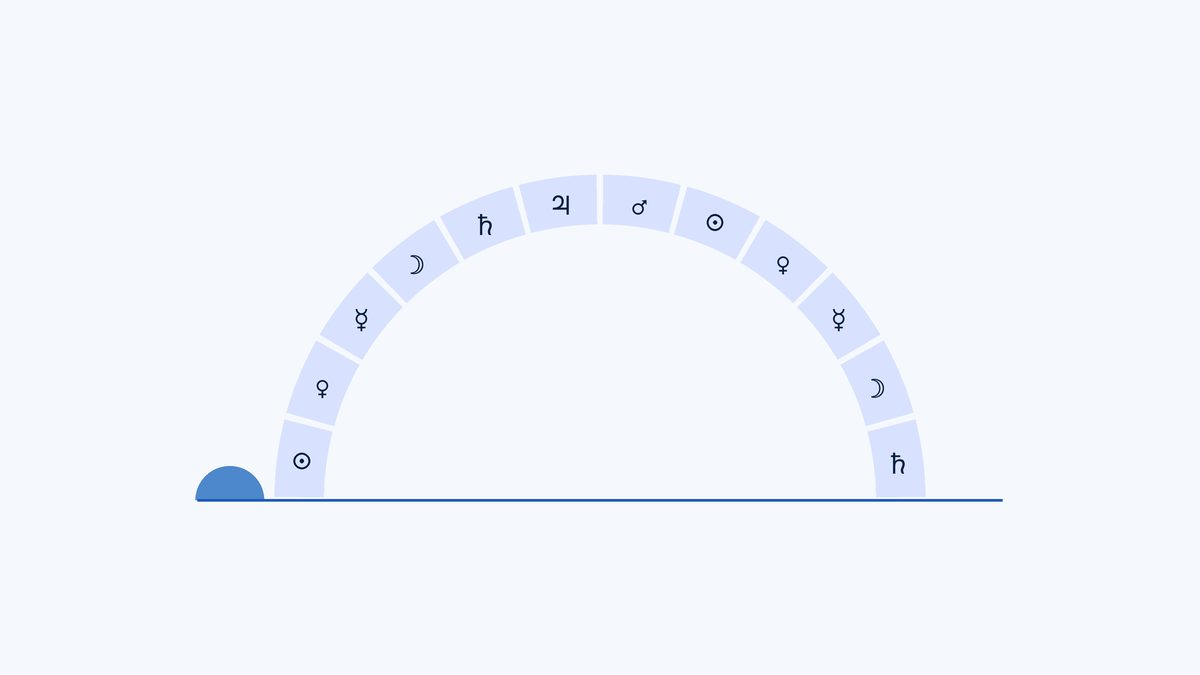
Which planet rules each hour?
The planets follow one fixed sequence: Saturn, Jupiter, Mars, Sun, Venus, Mercury, Moon. This is the traditional geocentric order used in the system. It is known as the Chaldean order. That name is modern and Wikipedia reports no evidence that the order came from Babylonian astrology.
The first hour after sunrise belongs to the day's own planet. The next hour takes the next planet in the sequence and the cycle repeats every seven hours.
| Day | Planet of the first hour | Planet of the first night hour |
|---|---|---|
| Sunday | Sun | Jupiter |
| Monday | Moon | Venus |
| Tuesday | Mars | Saturn |
| Wednesday | Mercury | Sun |
| Thursday | Jupiter | Moon |
| Friday | Venus | Mars |
| Saturday | Saturn | Mercury |
Why does Sunday follow Saturday? A day has 24 hours. Three full cycles of seven planets fill 21 of them and the last three hours take the next three planets. So the 25th hour, the first hour of the next day, lands three places down the sequence. From Saturn that is the Sun, from the Sun it is the Moon and so on. This is how the English day names line up with the planets.
A worked example: New York on 1 January 2027
We calculated sunrise and sunset for New York City with Astronomy Engine, an open-source astronomy library (version 2.1.19). Times are local Eastern Standard Time (UTC−5), rounded to the nearest minute. The calculation uses 40.7128° N, 74.0060° W, sea level and standard refraction. On Friday 1 January 2027 the Sun rises at 07:20 and sets at 16:39. That is 12:20 and 21:39 in UTC. The next sunrise is at 07:20 on 2 January.
- Day46.6
- Ngt73.4
- Fri♀
Daylight is 559.2 minutes. 559.2 ÷ 12 = 46.6. Night is 880.9 minutes. 880.9 ÷ 12 = 73.4. Friday is Venus's day.
In New York on 1 January 2027 the day hours are about 47 minutes long and the night hours about 73 minutes, starting with Venus at sunrise.
| Hour | Planet | From | To |
|---|---|---|---|
| 1 | Venus | 07:20 | 08:07 |
| 2 | Mercury | 08:07 | 08:53 |
| 3 | Moon | 08:53 | 09:40 |
| 4 | Saturn | 09:40 | 10:26 |
| 5 | Jupiter | 10:26 | 11:13 |
| 6 | Mars | 11:13 | 12:00 |
| 7 | Sun | 12:00 | 12:46 |
| 8 | Venus | 12:46 | 13:33 |
| 9 | Mercury | 13:33 | 14:19 |
| 10 | Moon | 14:19 | 15:06 |
| 11 | Saturn | 15:06 | 15:53 |
| 12 | Jupiter | 15:53 | 16:39 |
The first night hour, from sunset, goes to Mars. The 24th hour ends at the next sunrise and goes to the Moon. The hour after it is Saturn, the first hour of Saturday. In a city further north or south the same date gives different hours, so the table only holds for New York.
Where do planetary hours come from?
Planetary hours were developed in Hellenistic astrology and may have older roots in Babylonian astrology. The writers Vettius Valens and Dio Cassius explained the order of the days with them. Chaucer gave the same explanation in his Treatise on the Astrolabe.
The start of the day has moved. According to Vettius Valens, the first hour began at sunset. Modern astrology counts from sunrise.
Later, astronomical tables printed in the late 15th and 16th centuries often included a table of planetary hours. Wikipedia adds that their use was of limited importance to astrology as practised at the time. The astrologer Cornelius Gemma said he gave them little weight.
The 16th-century Key of Solomon, a book of magic, lists the tasks it thought suited to each planet's days and hours. For what tradition links with each planet, see what the planets mean in astrology. That is a tradition, not a measured effect.
Does NinePath calculate planetary hours?
No. NinePath does not calculate planetary hours. If you want to try them, you need the sunrise and sunset times for your own place and the steps above.
What this means for your day
For your day
Do
Look up today's sunrise and sunset where you are and work out one day hour.
Don't
Don't read a planetary hour as a promise of how something will turn out.
Questions people ask
Are planetary hours 60 minutes long?
They are close to 60 minutes near the equinoxes and throughout the year near the equator. In New York on 1 January 2027 a day hour lasts about 47 minutes and a night hour about 73 minutes.
Why is Friday linked with Venus?
Venus rules the first hour after sunrise on Friday in this system. Each day takes the name of the planet of its first hour, which is how the order of the week came about.
Does the planetary day start at midnight?
No. The planetary day starts at sunrise in modern astrology. Vettius Valens started it at sunset.
Sources
- Wikipedia: Planetary hours. The definition, the Chaldean order and its modern name, the 12 day and 12 night hours, the 25th-hour rule, the day names, Vettius Valens, Dio Cassius, Chaucer, the Renaissance tables, Cornelius Gemma and the Key of Solomon.
- Astronomy Engine, version 2.1.19. NinePath's own calculation of sunrise and sunset in New York City on 1 and 2 January 2027.
- What do the planets mean in astrology?. What tradition links with each planet.