Yes. Both words name the same thing in a birth chart: the zodiac sign climbing over the eastern horizon when and where you were born. The only difference is precision. The ascendant is an exact degree, and the rising sign is the sign that degree falls in.
Why does one sign have two names?
The name "rising sign" comes from movement: as the Earth turns, the zodiac seems to climb over the eastern horizon. The ascendant is the point where that horizon crosses the ecliptic, the Sun's yearly path through the zodiac.
The idea is old. By the 3rd century BCE, Egyptians watched which groups of stars were rising to tell the sign on the horizon and the rough time of night. The Greeks later called the ascendant horoskopos, or "hour marker".
What is the difference between the ascendant and the rising sign?
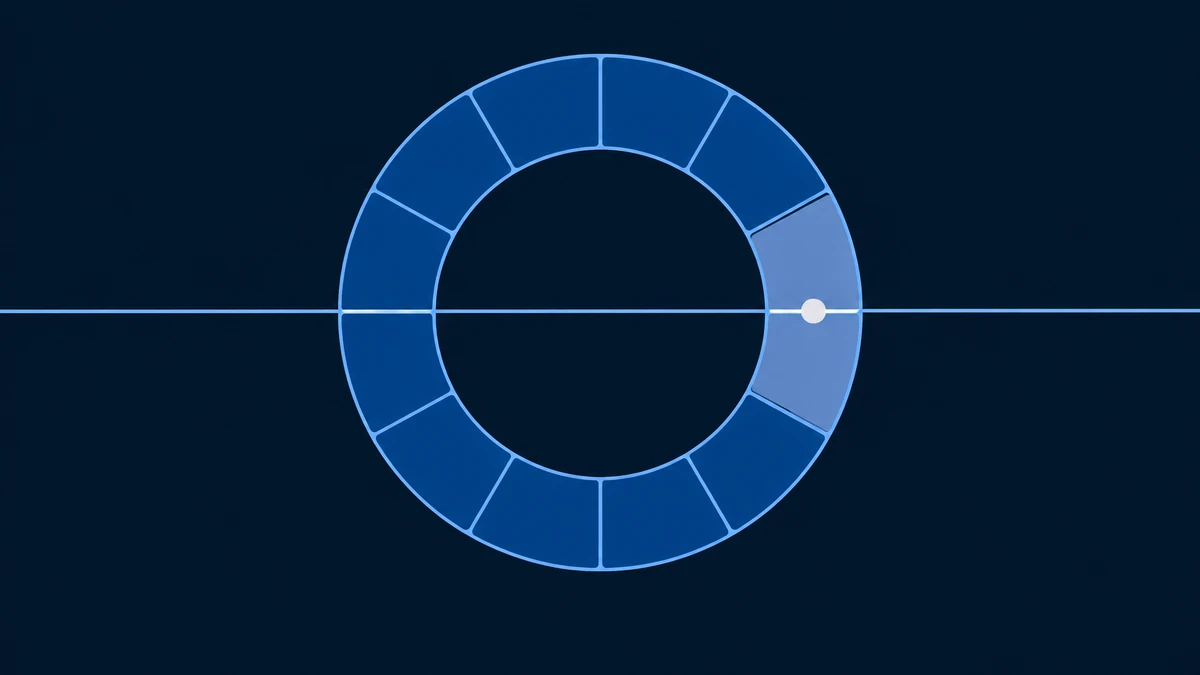
The zodiac is a circle of 360 degrees, split into twelve signs of 30 degrees each, starting at 0 degrees Aries. The ascendant is one exact position on that circle, given as a longitude. The rising sign is the 30-degree slice that position falls in.
| Sign | Longitude |
|---|---|
| Aries | 0 to 30 degrees |
| Taurus | 30 to 60 degrees |
| Gemini | 60 to 90 degrees |
| Cancer | 90 to 120 degrees |
| Leo | 120 to 150 degrees |
| Virgo | 150 to 180 degrees |
| Libra | 180 to 210 degrees |
| Scorpio | 210 to 240 degrees |
| Sagittarius | 240 to 270 degrees |
| Capricorn | 270 to 300 degrees |
| Aquarius | 300 to 330 degrees |
| Pisces | 330 to 360 degrees |
To find the sign, divide the longitude by 30. The whole number is how many signs come before it, counting from Aries, and the remainder is the degree inside the sign.
- Asc82.6
- Sign30
82.6 ÷ 30 = 2, remainder 22.6. Aries and Taurus come first, so the point is 22.6 degrees into the third sign, Gemini.
An ascendant at 82.6 degrees is about 22.6 degrees Gemini, so the rising sign is Gemini.
So "Asc 22°36′ Gemini" and "Gemini rising" describe the same chart. The degree only adds detail.
Where do you find the ascendant on a birth chart?
On a round chart, the ascendant is traditionally drawn at the nine o'clock position, on the left, and marked Asc or AC. Opposite it, at three o'clock, is the descendant: the point setting on the western horizon.
The exact degree matters most for houses, the twelve sections of a chart. In most house systems, the ascendant degree is where the first house begins. In whole-sign houses, the first house starts at 0 degrees of the rising sign instead, so only the sign counts there.
Your Rising sign and houses need your birth time and place. NinePath doesn't fill in a default time such as noon.
What this means for your day
For your day
Do
Read the sign next to Asc on your chart as your rising sign.
Don't
Don't count your ascendant and rising sign as two separate placements.
Questions people ask
Is a rising planet the same as the rising sign?
No. A rising planet is the planet nearest the ascendant, especially one in the first house. The rising sign is the sign of the ascendant itself, whether or not a planet sits near it.
Does the house system change my ascendant?
No. The ascendant comes from your birth time, your latitude and the tilt of the Earth's axis. House systems differ only in how they divide the chart after that point.
Can the ascendant sit right between two signs?
It can sit at the very end of one sign. The ascendant passes through the whole zodiac in about a day, an average of one degree every four minutes (360 degrees in 24 hours), and its speed varies with latitude. So a small change in birth time can then give the next sign.
Sources
- Wikipedia: Ascendant. The definition, the calculation from local sidereal time, axial tilt and latitude, the Egyptian and Greek history (horoskopos), and the rising planet.
- Wikipedia: Horoscope. The angles of a chart: the ascendant at the nine o'clock position, the descendant opposite, and the term "rising" sign.
- Wikipedia: House (astrology). The ascendant as the cusp of the first house in most systems, and the whole-sign rule.
- Wikipedia: Astrological sign. Twelve 30-degree signs counted from the first point of Aries.